
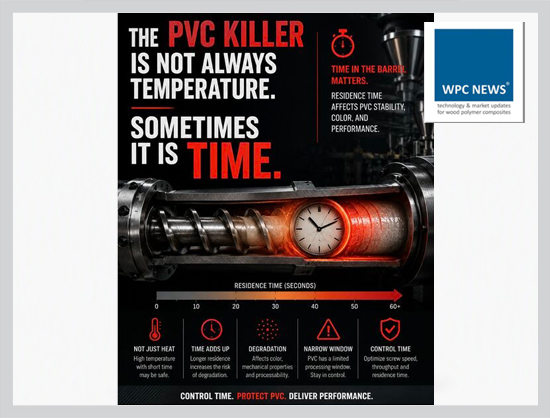
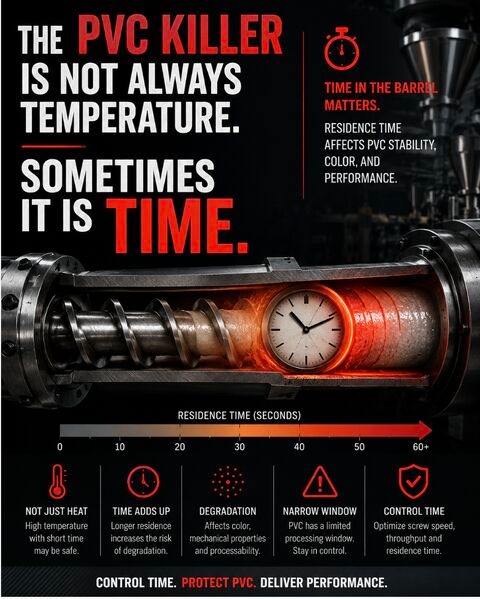
Residence time drift is the PVC killer many lines underestimate.
Everyone checks the temperature.
Barrel zones.
Die zones.
Melt temperature.
Cooling water.
But one question gets missed too often:
How long did the PVC actually stay hot?
That is where residence time matters.
And in PVC, time under heat can be just as important as temperature itself.
The dangerous part is that residence time drift rarely announces itself.
It creeps in quietly:
Screw speed changes.
Feeding becomes unstable.
Output drops.
Back pressure increases.
Screen pack starts restricting flow.
Die build-up grows.
Screw wear changes conveying.
Material hangs up in a dead zone.
Operators slow the line to “stabilize” it.
The set temperatures may look the same.
But the PVC may be spending longer under heat, shear, or stagnant flow.
That extra history can show up as:
yellowing
Odor
black specks
plate-out
burn marks
gloss loss
lower thermal stability
weaker mechanical properties
The trap?
Residence time problems often look like stabilizer problems.
So people add more stabilizer.
Or change the lubricant.
Or blame the resin.
But the root cause may be simpler:
The material stayed hot for too long, or got trapped where it should have kept moving.
PVC does not only degrade because it got too hot.
It can degrade because it stayed hot too long.
Good processing is not just temperature control.
It is time-temperature-flow control.
Because in PVC extrusion, the clock inside the barrel matters.
Even when nobody is watching it.
#PVC #PVCProcessing #Extrusion #ProcessControl #PVCCompounding #MaterialsScience #PlasticsProcessing
By: ORBIMIND AB (https://lnkd.in/p/dPJW2acA)